You are given 101 single-coloured, perforated beads and a piece of string. Of these beads, 50 are red and the remaining 51 are blue. The holes in the beads are just large enough for the string to be threaded through each bead only once. The string is long enough to thread all 101 beads onto it.
It is precisely this sort of situation that the country’s most talented mathematicians face once a year at the state round of the Mathematics Olympiad in Göttingen. The question almost arises of its own accord. Investigate whether it is possible to thread all these beads onto the string in such a way that no two beads of the same colour ever follow one another.
But how do you solve such a problem? “The best approach is to simplify the problem first,” explains teacher Martin Glosemeyer from Georgianum Grammar School in Lingen. Instead of selecting 101 beads, we start with three. Two are blue, one is red. The problem is simple. Because with blue, red and blue, it is easily possible to string the beads onto the thread. The problem can now be quickly extended to 101 beads. “This principle is a powerful one in mathematics and in life,” says Glosemeyer. And it is with such fundamental ideas and strategies that the children and young people in Göttingen spend a whole weekend. At the Georgianum, in fact, they do so all year round. With the Mathematics Club and the revolving-door model, there are two key components of the STEM concept. In the mornings, the top pupils in Years 5–8 are taken out of their normal lessons for two hours once a month during the second half of the school year as part of the revolving door model. They receive instruction in logic, geometry, combinatorics, algebra and number theory, which goes beyond the standard school curriculum and explicitly prepares them for maths competitions. In the afternoons, content at a high mathematical level is always taught on Wednesdays in the maths club.
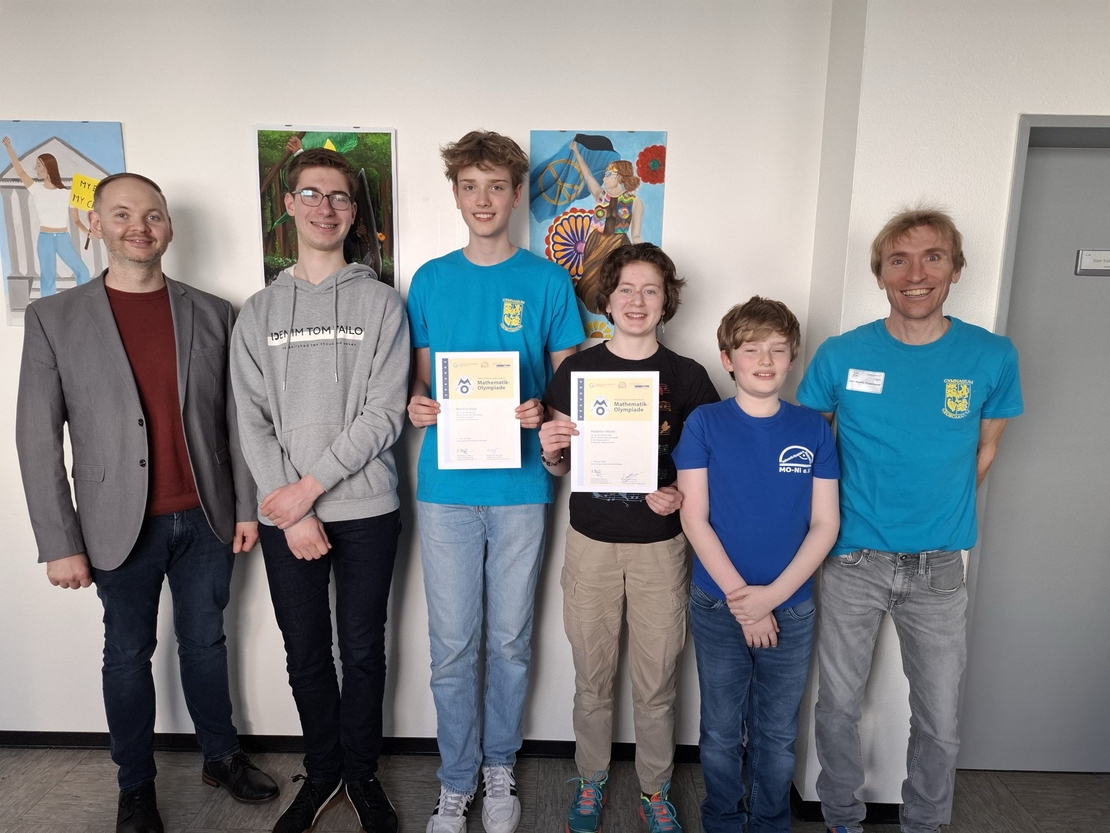
The task involving the beads and the thread had to be solved by Matthias Klaas from Year 8. He had qualified for the state round together with Tjark Thönnißen (Year 6), Madelon Hibbel (Year 10) and Jano Gerling (Year 11). “This is only the second time in the Georgianum’s 15-year history that we’ve been able to send four pupils to Göttingen,” says Glosemeyer happily, attributing this success to the Georgianum’s educational approach. Thönnißen even won a commendation prize, whilst all the others received a certificate and gained a wealth of valuable experience.
For Matthias, there was a second part to the task: “Investigate whether it is possible to thread all these beads onto this string in such a way that, even after joining the ends of the string, no two beads of the same colour (including across the joining point) ever follow one another.”
Joy among organisers and participants of the Mathematics Olympiad, which took place in Göttingen.
Text: Martin Glosemeyer, Image: Emil Zeller