The end of the Second World War left the Jewish community grappling with the trauma of the Shoah, which would go on to affect all subsequent generations. We, the students of the seminar course ‘80 Years On – Using History for Democracy’, asked ourselves in our podcast how Jews in our region deal with the memory of the Shoah today, how they view their position in our society, and how they feel about global anti-Semitic conflicts and acts.
To this end, we interviewed key figures, primarily from regional institutions, namely: Mr Grünberg, the chairman of the Jewish Community of Osnabrück; Ms Spiegelberg and Mr Hüsken from the Emsland/Grafschaft Bentheim police station; and Mr Wolski-Prenger from Forum Juden-Christen, a registered association for Christian-Jewish cooperation.
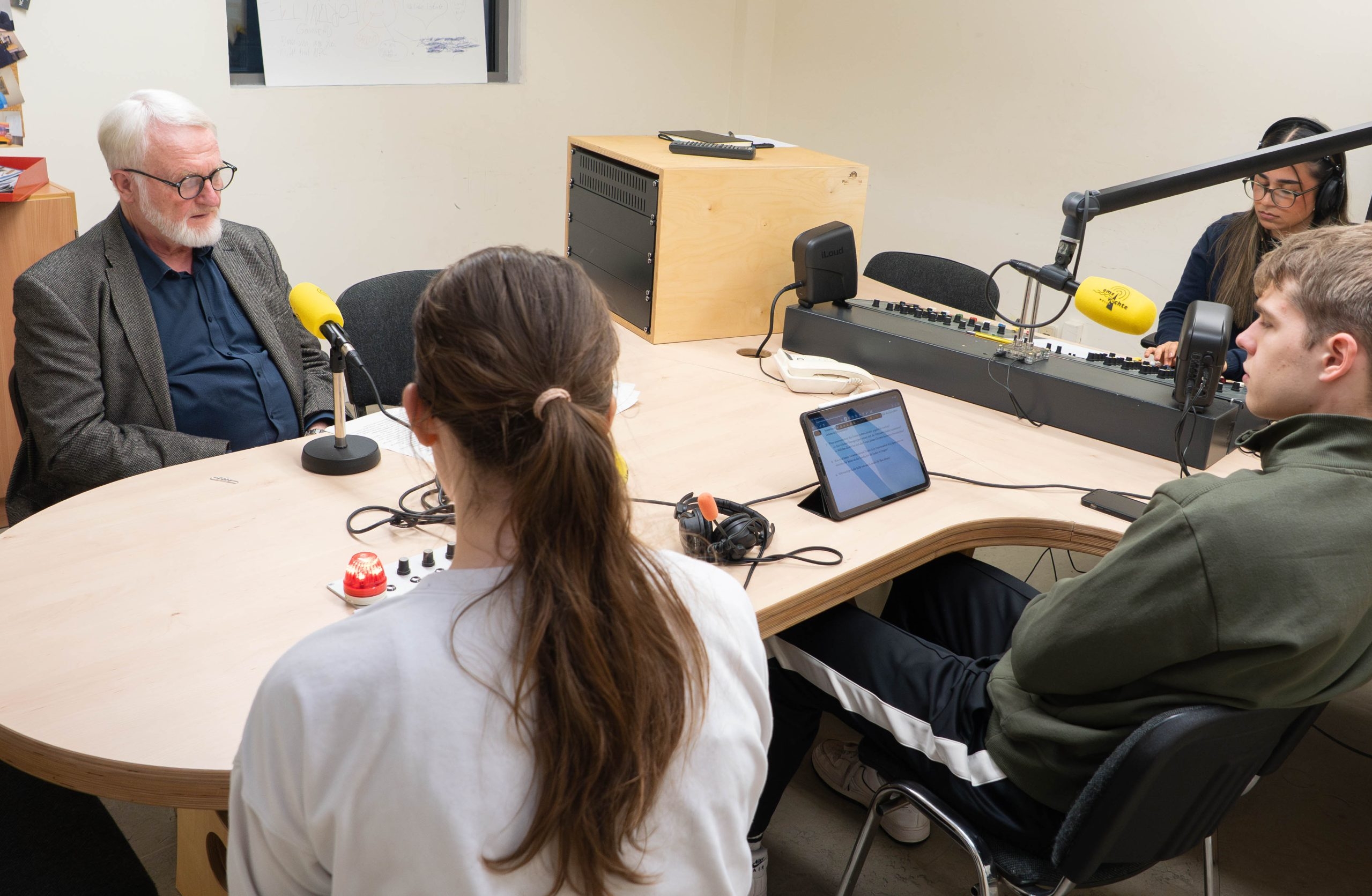
Mr Wolski-Prenger spoke about how Jewish life in Germany developed after the Holocaust and explained to us what is meant by the term ‘anti-Semitism’.
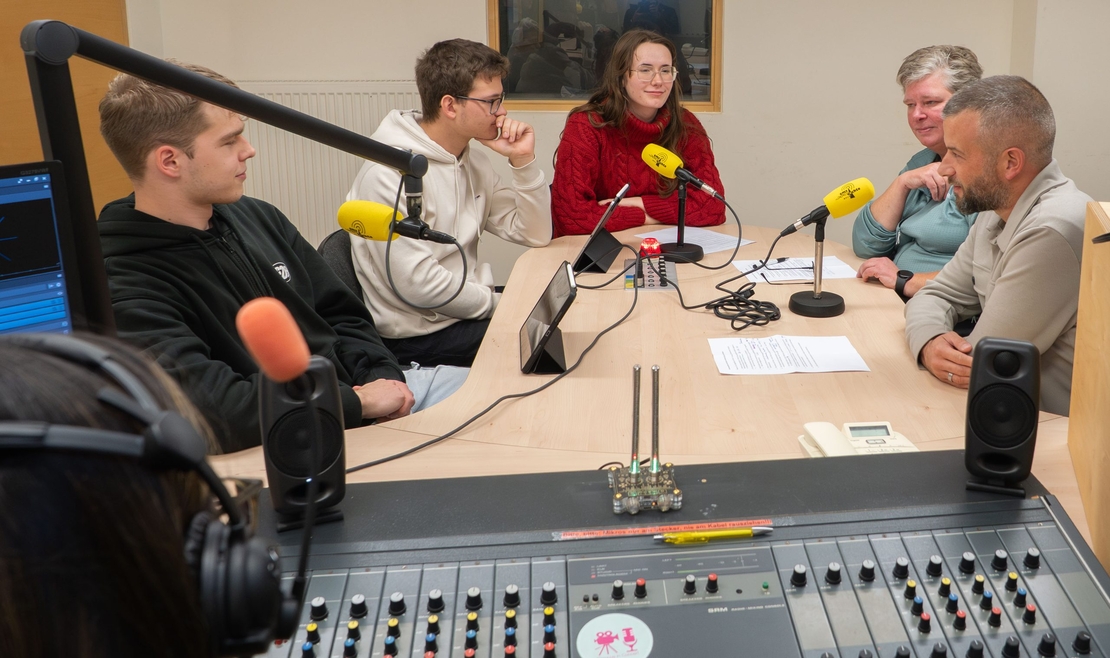
We spoke to Ms Spiegelberg and Mr Hüsken from the Emsland/Grafschaft Bentheim Police Station about legal protection against anti-Semitic crimes and about the criteria investigators use to make an initial assessment of whether an offence is anti-Semitic in nature or not.
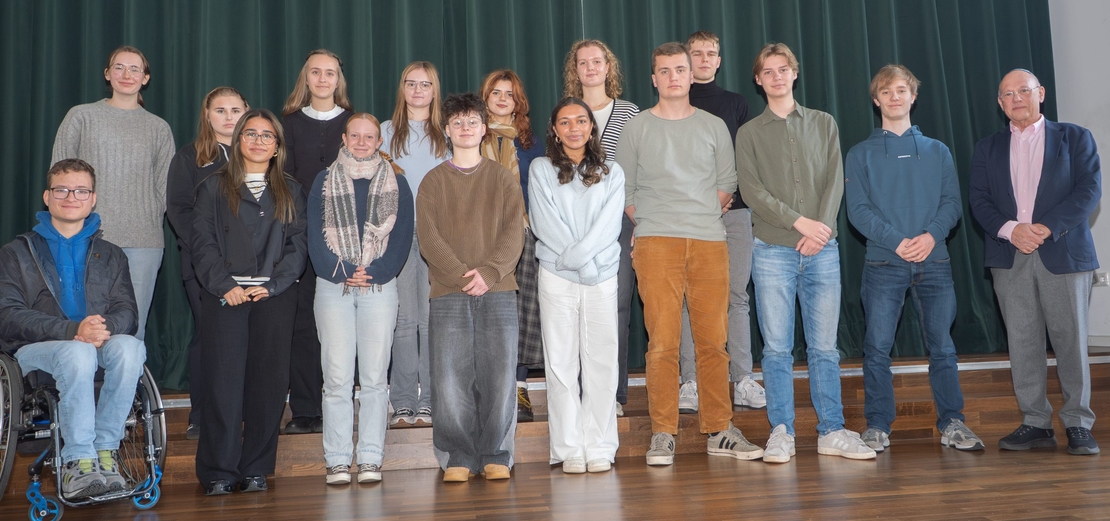
We pupils had a particularly open discussion with Mr Grünberg at the premises of the Jewish Community of Osnabrück. The chairman of the Jewish Community gave a moving account not only of his parents’ fate after 1945, but also of the rebuilding of the community and the current situation of Jewish people in Germany.
Through our work on the topic ‘Jewish Life Today’, we have gained many new insights into the situation of Jews in Germany. It became particularly clear just how diverse Jewish life is today; yet it was also surprising to see how community life can be sustained with just a few scattered members, and how this strong sense of connection shapes the identity of our Jewish fellow citizens.
We learnt that there is no such thing as ‘THE’ German Jewish faith. It was precisely the discussions with Mr Grünberg and Mr Wolski-Prenger that showed us how differently the Jewish faith is practised in Germany.
The new experiential space was particularly impressive. We gained insights from three fascinating perspectives that would not have been possible without this project. The in-depth explanations regarding the origins of anti-Semitism, its evolution into contemporary forms, and the associated dangers for Jewish life were also both deeply moving and alarming.
We consider this engagement with Jewish life in the Federal Republic to be very important, as it helps to break down prejudices, promote understanding and consciously strengthen the values of equality, humanity and democracy. Our engagement was an enriching experience for us, which demonstrated how important remembrance work, dialogue and active listening are for our society.
Anti-Semitism can only be overcome through education and awareness-raising. In this respect, we consider a more in-depth engagement with the topic – including, and particularly, in schools – to be urgently required and absolutely essential. Podcasts such as this one can certainly contribute to this, provided they themselves encourage critical reflection. Ultimately, it is the task and duty of us all to treat one another with respect and tolerance and to work on prevention in order to counter anti-Semitism and thus prevent discrimination. For – as Mr Grünberg rightly emphasises – and as should, indeed must, be a matter of course for us as pupils and fellow citizens: I am just as much a German as you are
We would like to thank our interviewees warmly for their openness and willingness to answer our questions. We would like to thank Ems-Vechte-Welle for their professional technical support.
Text: Students of the seminar course, photos: Stefan Roters.