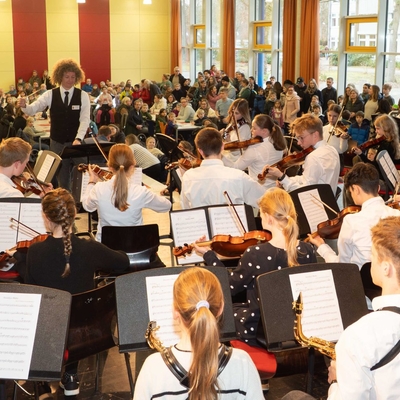
The string ensemble and the string section of the Emsland Youth Orchestra, conducted by Mr Neubauer, opened the event in the canteen with a sample of their musical talent. Accompanied by Mr Badde on the piano, the young musicians first performed the piece “Dorothy’s Waltz” by Andrea Holzer-Rhomberg to a packed canteen.
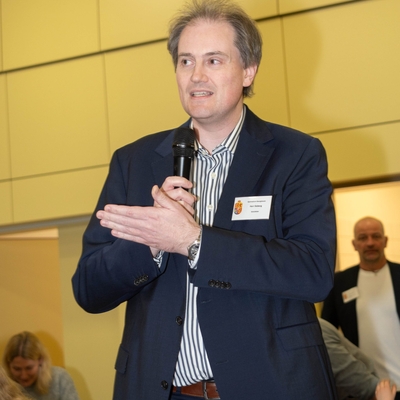
Following the first musical performance, Headteacher Lucas Sieberg warmly welcomed the guests to our school. In his brief address, Mr Sieberg expressed his delight that so many primary school pupils had made their way to the Georgianum. Admittedly, the upcoming decision as to which secondary school their path would lead them to in the summer was a difficult one; however, the Georgianum school community had put together a varied programme to make the decision-making process easier. The many activities and stands run by Georgianum pupils, as well as the wealth of information on subjects and specialisation streams, would certainly give a broad impression of the opportunities on offer.
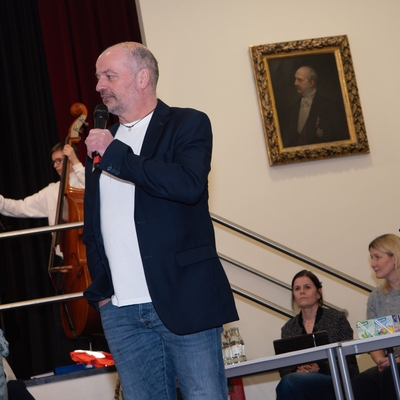
Mr Kösters gave an equally warm welcome to all the primary school pupils and, on behalf of the school, expressed particular thanks to the parents’ representatives for the impressive organisation of coffee and cake for our guests. In his words of thanks, the coordinator for this event also included the student council, who would be offering school tours over the following hours.
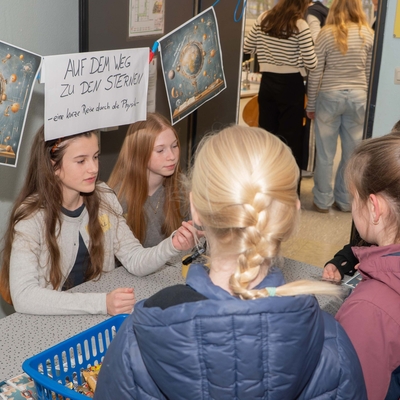
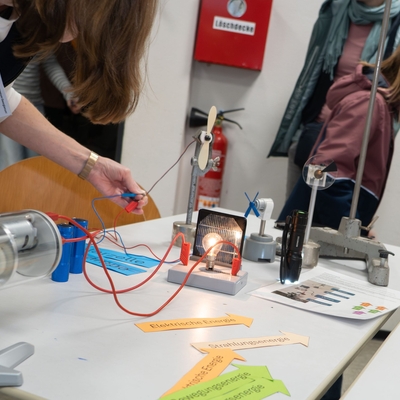
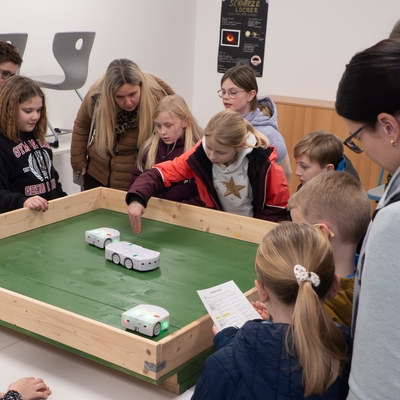
“On the Way to the Stars” – that was the title of the Physics Society’s activity trail. At the entrance to each station, the young researchers were patiently shown how best to navigate the five-station educational trail.
At the “Energy Transfer” station, the task was to use a hand crank to power a dynamo and light up the lamp in the middle ground; the light from this lamp was then supposed to power the small propeller via the solar panel.
Pupils from our school’s STEM subject stream presented Thymio, a small mobile robot. Here, the young visitors had to steer and guide the moving robot by touching the sensors attached to the front and sides.
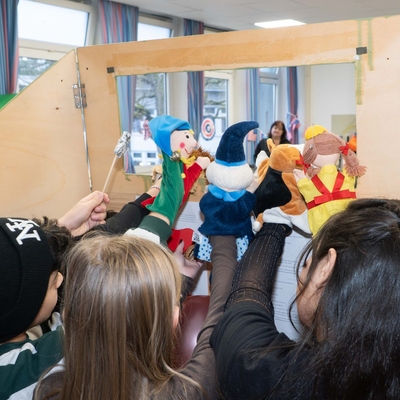
The English department put on an engaging puppet show for the audience. The pupils from the so-called ‘International Class’ performed ‘The Wizard of Oz’ by L. Frank Baum in English.
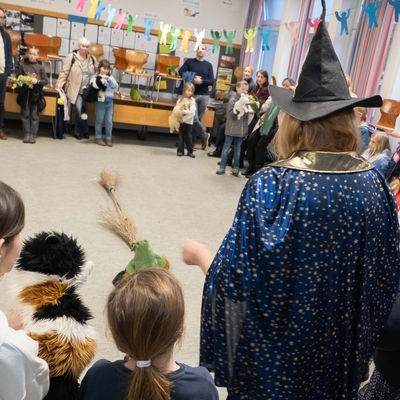
Ms Wernke, the leader of the Froggy Club, presented material from her English-language drama club. To this end, she playfully acted out a scene from “Room on the Broom” using hand puppets. Following English instructions and their repetition, the young performers placed their hand puppets on the two brooms laid out in the middle of the room.
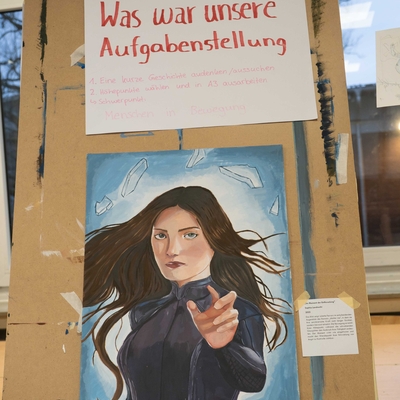
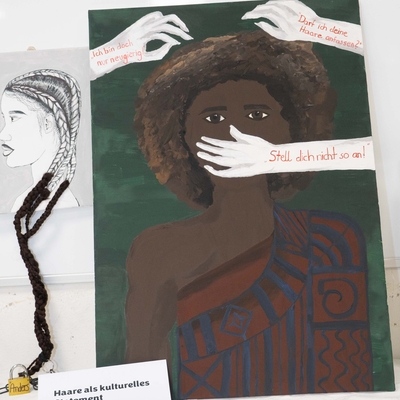
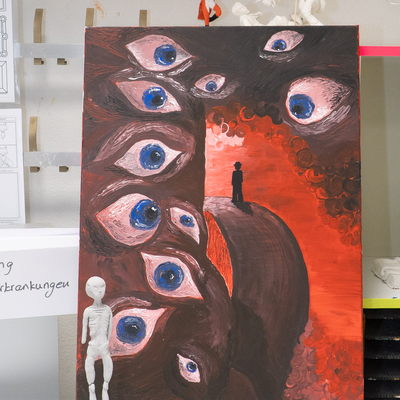
The Art Department showcased works by pupils from various year groups. The advanced course for Year 12 pupils presented works on the overarching theme of ‘People in Motion’. For this, Ms Oeldig asked the pupils to choose or invent a short story and then depict the story’s key moments artistically.
For example, Sophia Landwehr presented “Im Moment der Entfesselung” (In the Moment of Unleashing), depicting the scene from the novel “Shatter Me” in which the protagonist, Juliette Ferrars, becomes aware of the targeted use of her power.
The 13th-year advanced course, led by Ms Krey, exhibited works on the overarching theme of “Artistic Research”, in which the artists were required not only to create their own piece but also to document the process leading up to its completion.
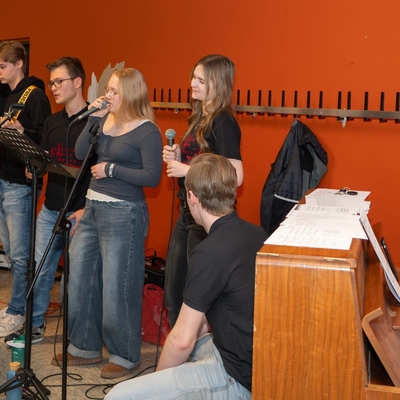
In the Music Department, the percussion club ‘Groovebox’ and – as seen in the photo – ‘Georgie’s Groove Orchestra’ showcased their skills.
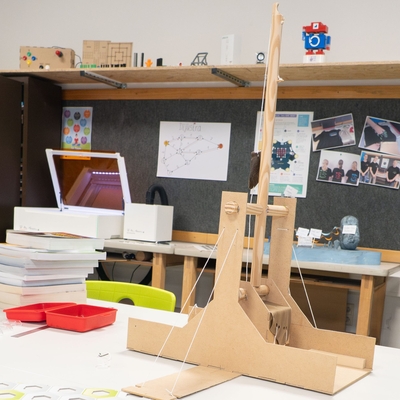
The Maker Club, led by Mr Felschen, presented a replica of a trebuchet, the largest throwing weapon among medieval siege engines.
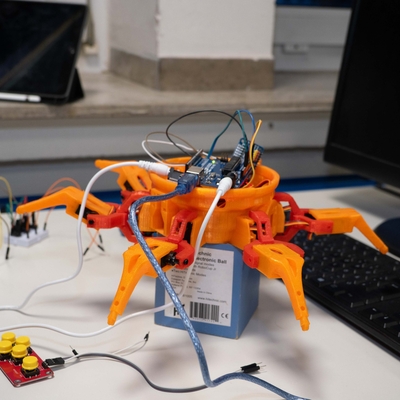
A second eye-catcher in the Maker Space was ‘Joseph the Crab’. Here, attempts were and continue to be made to get a model created years ago using a 3D printer up and running. In addition to controlling the 12 motors required to move the crab’s legs, the constant power supply is seen as the main obstacle to continuous movement.
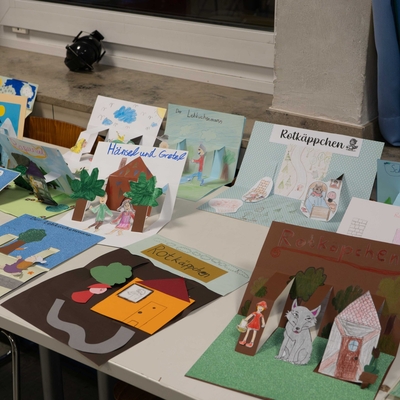
The German department welcomed the young visitors with fairy-tale pop-ups and Quadramas. For example, the pop-ups depicted the main characters and settings of well-known fairy tales.
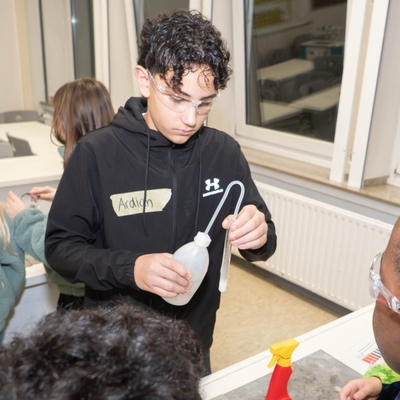
In the Chemistry Department, primary school pupils and visitors used red cabbage juice as an indicator to determine whether a solution belonged to the spectrum of acids or bases.
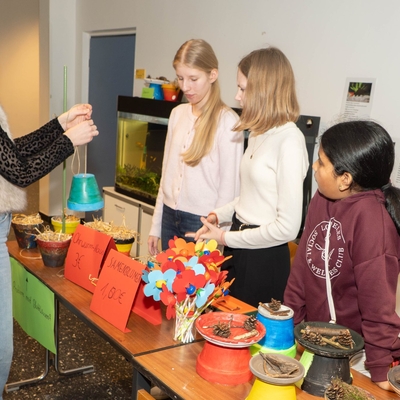
To the delight of gardeners among the visitors, the Environmental Working Group, led by Ms Stockhorst, offered ‘seed flowers’ and ‘insect watering holes’ for sale, as well as ‘earwig houses’. These flowerpot-shaped houses provide shelter and a safe place for the Forficula auricularia to breed; they are also known as earwigs or common earwigs. Even though their musical relatives can be quite a nuisance to humans, these flying insects are considered beneficial. They are only hostile to aphids, as they enjoy eating these pesky insects.
Text and photos: Stefan Roters.